
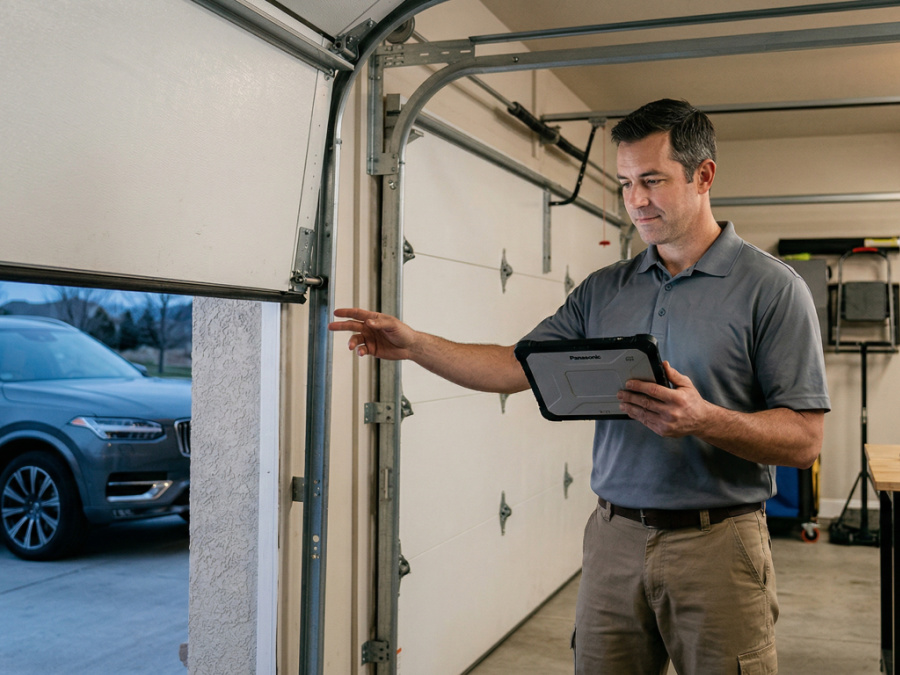
The Quiet Takeover: How AI Found Its Way Into the Garage Door Industry
Over the past year, I have started noticing a pattern in places most people would not think to look for it. Not in tech startups or software companies, where it is expected, but in industries built on physical work, routine service calls, and decades of hands on experience. The kind of businesses where the job still depends on a truck, a set of tools, and knowing exactly how to fix something that weighs a few hundred pounds and does not want to cooperate.
Garage door repair is one of those industries. And yet, it is quietly becoming one of the clearest examples of how artificial intelligence is actually being adopted in the real world. Not through sweeping disruption, but through small, practical improvements that compound quickly. A missed call gets answered anyway. A customer receives a follow up without having to chase it. A technician shows up already understanding the likely issue before the door is even halfway open.
To the homeowner, it feels like better service. To the operator, it is something else entirely.
It is operational leverage.
AI Is Not Replacing the Work It Is Reshaping the Edges
The popular narrative around AI tends to focus on replacement. Jobs disappearing, systems taking over, entire industries being redefined overnight. That is not what is happening here. In the garage door space, AI is not replacing the work. It is tightening everything around the work. Communication, scheduling, diagnostics, and the dozens of small inefficiencies that used to be accepted as part of doing business.
This is where AI is gaining traction. Not in the headline moments, but in the operational gaps. Missed calls, delayed responses, incomplete job details, inefficient routing. These are not glamorous problems, but they are the ones that quietly drain time, revenue, and customer trust.
And they are exactly where AI performs best.
Customer Expectations Are Driving Adoption Not Technology
One of the more important shifts is not happening inside these businesses. It is happening outside them. Homeowners have been conditioned by faster, more responsive service in nearly every other part of their lives. They expect immediate answers, clear communication, and minimal friction.
Garage door companies are not adopting AI because it is innovative. They are adopting it because customer expectations have changed, and the businesses that meet those expectations consistently are the ones that win.
That pressure does not announce itself loudly. It shows up in lost leads, slower response times, and subtle differences in how customers choose who to call.
From Missed Calls to Closed Loops Where AI Creates Leverage
When I spoke with Maxim Geht, owner of Ohio Garage Door Repair in Aurora, Ohio, he framed the shift in terms that resonate far beyond his industry. Time, efficiency, and control over the customer experience.
He views AI through the lens of customer lifecycle management. In his words, it is not about replacing the technician’s hands. It is about protecting the technician’s time. By using AI to automate lead intake, qualification, and even early stage diagnostics, his team avoids the constant back and forth that slows down traditional service workflows.
By the time a technician arrives, the situation is already clarified. The customer understands what is happening, the likely issue has been narrowed, and the job is moving forward rather than starting from zero. What used to be a fragmented process with missed calls, delayed callbacks, and incomplete details becomes a closed loop.
In a service business, that shift does not just improve efficiency. It directly impacts conversion rates, customer satisfaction, and overall profitability.
The New Competitive Divide Organized Versus Disorganized Operators
The real divide is not between companies that use AI and those that do not. It is between companies that are operationally organized and those that are not.
AI does not fix a broken business. It amplifies whatever system is already in place. For disciplined operators, it creates leverage. Faster response times, tighter communication, better job preparation. For disorganized companies, it often just adds another layer of noise.
What is emerging is a quiet but meaningful shift in the competitive landscape. Smaller, well run garage door companies now have access to the same level of responsiveness and communication that used to require a full office staff. AI is, in effect, leveling the playing field.
It is no longer about who has the biggest team. It is about who runs the tightest system.
The Last Mile Still Belongs to Skilled Technicians
For all the discussion around automation and efficiency, the core of the job has not changed and likely will not anytime soon.
A garage door still requires physical expertise. Springs remain under extreme tension. Tracks must be aligned with precision. Safety is non negotiable. No software is stepping in to replace that.
What AI is doing instead is clearing the path so that when a technician arrives, they can focus entirely on the mechanical problem, not the confusion leading up to it. In a trade where time on site directly impacts profitability, that distinction matters.
What an AI Enabled Service Workflow Actually Looks Like
To understand what this looks like in practice, consider how a typical service call used to unfold compared to how it operates now.
Traditionally, a customer calls, leaves a message, waits for a callback, explains the issue again, and schedules a visit based on limited availability. The technician arrives with partial information and diagnoses the problem from scratch.
In an AI supported workflow, that process compresses. The initial inquiry is captured immediately. Follow up happens without delay. Key details are gathered upfront. Scheduling is optimized based on location and availability. By the time the technician arrives, they are not starting from zero. They are stepping into a prepared situation.
The work itself has not changed. The efficiency around it has.
Consistency Across Markets From Ohio to Colorado
This shift is not isolated to one region or one type of operator. It is showing up across very different markets.
In Estes Park, Colorado, where geography and seasonal demand create constant pressure on scheduling and communication, David Burton of Quality Garage Door Services of NOCO is seeing similar results. In his operation, AI serves as a stabilizing force. It helps manage communication across homeowners, property managers, and rental properties without losing track of details.
In a market where timing and coordination are critical, that consistency becomes a competitive advantage.
The Risk of Sameness and the Value of Staying Human
There is, however, a subtle risk that comes with widespread adoption. As more companies implement similar tools, customer experiences can begin to feel identical. The same types of automated responses, the same communication patterns, the same workflows.
In an industry built on trust, that sameness can become a liability.
The operators who stand out are the ones using AI to support their business without letting it replace their identity. The technology handles the gaps while the company itself still feels human, responsive, and accountable.
That balance is where the real advantage lives.
The Bigger Signal for Business Owners
What is happening in the garage door industry is not a technological revolution. It is an operational one.
AI is not changing what the work is. It is changing how efficiently that work gets done, how clearly it is communicated, and how consistently it meets rising customer expectations.
For business owners, that is the real signal. Not that AI is coming, but that it has already begun to redefine the baseline for service. Once that baseline shifts, it does not move back.
The advantage will not go to the companies that adopt AI the fastest. It will go to the ones that integrate it effectively, using it to tighten their systems without losing the discipline and trust that built their business in the first place.